Hey ! Thanks for Reading.

The deSlopification Framework: A Guide to Building High-Signal Content in the AI Era

The goal is not to create content without AI. It's to create content that AI, on its own, could never create. We do this by building a uniquely human strategic foundation and then using AI as a powerful tool for scale and execution.

This framework is built on a three-stage process: Define, Develop, and Deploy.

LAMB - News_OctoberLanding

HEURISTIC

The 3D Process

Define

Define precisely who you are, who you're talking to, and the unique voice you'll use to connect with them.

Develop

Next, develop your authority by strategically mapping out the core topics and expert angles that you will own.

Deploy

Deploy your content at scale by using AI as a powerful tool to execute your human-led strategy, not create it.

The Gold Rush Is a Lie

In 1849, a carpenter found a few gold flakes at Sutter's Mill, and the world went mad. Hundreds of thousands of prospectors rushed to California, convinced that fortunes were lying on the ground for the taking. Most of them found nothing but mud, debt, and disappointment. The only people who got rich were the ones selling the shovels.

The AI content boom feels a lot like that.

The internet is flooded with AI-generated "slop"—generic, soulless articles that sound vaguely correct but say nothing of value. The default reaction is to either join the noise, hoping volume will win, or to retreat, hoping quality alone is enough. Both are losing strategies.

The goal is to create content that AI, on its own, could never create. This framework shows you how. We’ll build a uniquely human foundation and then use AI as a powerful tool to scale your voice, not just your word count.

Define Your Foundation: the 'Who' & 'Why'

Before you write a single word, you must know who you are and who you’re for. This stage builds the bedrock that makes your content impossible for a machine to replicate.

Audience Archetypes — From Persona to Person

Most marketing personas are useless demographic checklists. "Marketing Mary, 35-45, works at a SaaS company" doesn't help you write a single meaningful sentence. It’s a cardboard cutout. We need to create a profile of a real person.

The Archetype Approach focuses on what’s happening inside their head:

  • Jobs-to-be-Done (JTBD):
    Forget what they buy. What is the fundamental progress they are trying to make in their work or life? Are they trying to "get their team to trust the new system" or "finally leave the office at 5 p.m. without feeling guilty"?

  • The Pain Matrix:
    What are their real frustrations and fears? Go deeper. The first-level pain might be "our meetings are too long." The second-order consequence is "my best engineer is about to quit out of frustration". That’s where the real story is.

  • The Aspiration Map:
    What does success look like in their own words? What is the future state they dream about? Is it a seamless workflow, or is it the feeling of being seen as an innovator by their boss?

  • Watering Holes & Language: Where do they gather online to complain or ask for advice? Listen. The specific vocabulary, acronyms, and phrases they use are your greatest source of intelligence.

Your output here is a one-page Archetype Brief that feels so real, you could almost have a conversation with it.

The Brand Voice Blueprint: Codifying Your Distinction

"Friendly and professional" isn't a voice; it's the default setting for a robot. A memorable voice comes from making deliberate choices. We define ours with four levers:

  • Density:
    How complex are your ideas? Are you explaining foundational concepts for beginners, or are you exploring nuanced arguments for experts?
  • Spectrum:
    Simple & Foundational <---> Complex & Nuanced

  • Vocabulary:
    What words do you use? Do you stick to plain English, or do you use industry jargon because your audience expects it?
  • Spectrum:
    Plain English <---> Industry Jargon

  • Cadence: What is the rhythm of your writing? Are your sentences short and punchy, designed for impact? Or are they longer and more narrative, designed to tell a story?
  • Spectrum:
    Short & Punchy <---> Flowing & Narrative

  • Stance:
    What is your relationship with the reader? Are you the expert lecturing from a stage, or the trusted guide walking alongside them?
  • Spectrum:
    The Sage on the Stage <---> The Guide on the Side

The output is a Brand Voice Blueprint with clear rules and examples. For instance: "We use cooking analogies to explain economic policy. We never use empty words like 'revolutionary'. Our sentences are declarative and assured".
LAMB - News_OctoberLanding_Info

Develop Your Authority:  the 'What'

With your foundation set, you can now define the territory you will own. This isn't about random acts of content; it's a deliberate strategy for becoming the go-to authority.

The Authority Venn Diagram — Finding Your Content Pillars

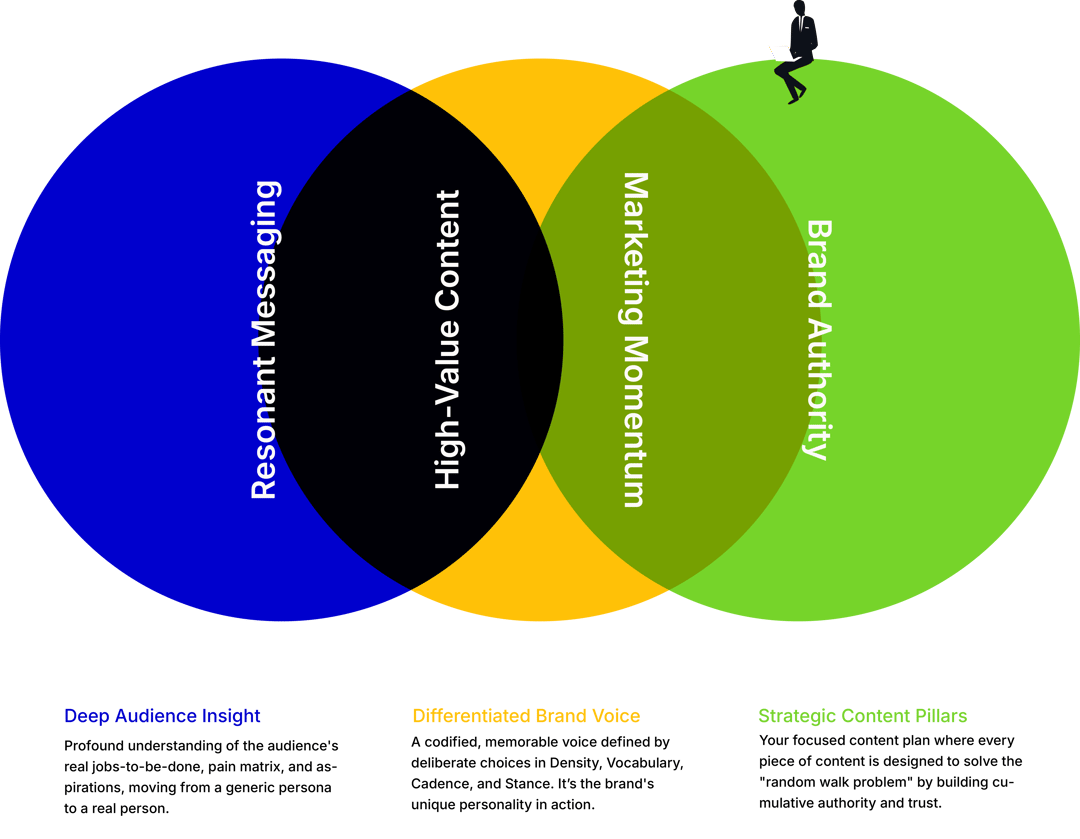
Your best content—your pillars—exists at the intersection of three circles:

  1. Your Audience's Obsessions:
    The core problems, pains, and aspirations you identified in your Archetype Brief.
  2. Your Business's Solutions:
    The unique value your product or service provides to solve those problems.
  3. Your Authentic Expertise:
    What you and your team know better than anyone else, based on real-world experience.

The Litmus Test: If a topic doesn’t hit all three circles, it’s not a pillar. It’s noise. You’ll produce a list of 3-5 core Content Pillars that you will commit to owning completely.

The Topic-to-Territory Model

This model creates a nearly endless stream of content ideas that are always on-strategy.

  • Territory:
    The broad domain you operate in (e.g., Small Business Marketing).
  • Pillars:
    Your 3-5 areas of focus (e.g., Lead Generation, Content Strategy, Marketing Automation).
  • Topics:
    Specific questions your audience asks about each pillar (e.g., "How do I create a lead magnet that converts?").
  • Angles:
    Your unique, opinionated take on the topic. This is where your voice and expertise create distinction. An angle turns a generic topic into something only you could write (e.g., "Why Your Lead Magnet Fails: It's a Brochure, Not a Painkiller").

The output is a content map connecting your high-level strategy to specific, actionable ideas.

Deploy at Scale: the 'How'

Now, and only now, do we bring in the AI. We don’t use it as a creator; we use it as an accelerator. With a robust, human-led strategy, tools can scale your output without sacrificing your soul.

The Human-AI Workflow

This is a non-negotiable, three-step process for every single piece of content.

  1. The Human Strategist:
    You create a detailed creative brief using your work from Parts 1 & 2. It includes the Target Archetype, Pillar, Topic, Angle, key talking points, data to include, and the Brand Voice Blueprint.
  2. The AI Assistant:
    The AI generates a first draft based only on your detailed brief. Its job is to do the heavy lifting of structure and basic writing, not to have original thoughts.
  3. The Human Expert:
    You take the draft and add the irreplaceable value. You refine the language, insert unique stories, add proprietary data, and ensure the final piece has a human touch. This step is your final defense against slop.

Crafting the Master Prompt

The quality of AI output depends entirely on the quality of the input. This reusable Master Prompt Template turns your strategy into a clear set of instructions for your AI assistant.

  • Act as [Brand Persona] from my Brand Voice Blueprint...
  • Write for my [Audience Archetype], who struggles with [Pain Point] and aspires to [Aspiration]...
  • The topic is [Topic], which is part of our [Pillar]...
  • Our unique angle is [Angle]...
  • Incorporate these key ideas and data points: [List of talking points]...
  • Adhere strictly to these voice rules: [Your specific Brand Voice Blueprint rules]...

This turns AI from a generic content farm into a highly efficient, on-brand collaborator, ready to help you build your authority at scale.